Great Theatre, Library Of Celsus And Curetes Street On A Biblical Tour
The Great Theatre is where the Acts 19 crowd rushed; the Library of Celsus is the most photographed facade in the ancient city; Curetes Street connects them. Here is how a guided visit walks all three, and what the terrain actually involves.
Short answer
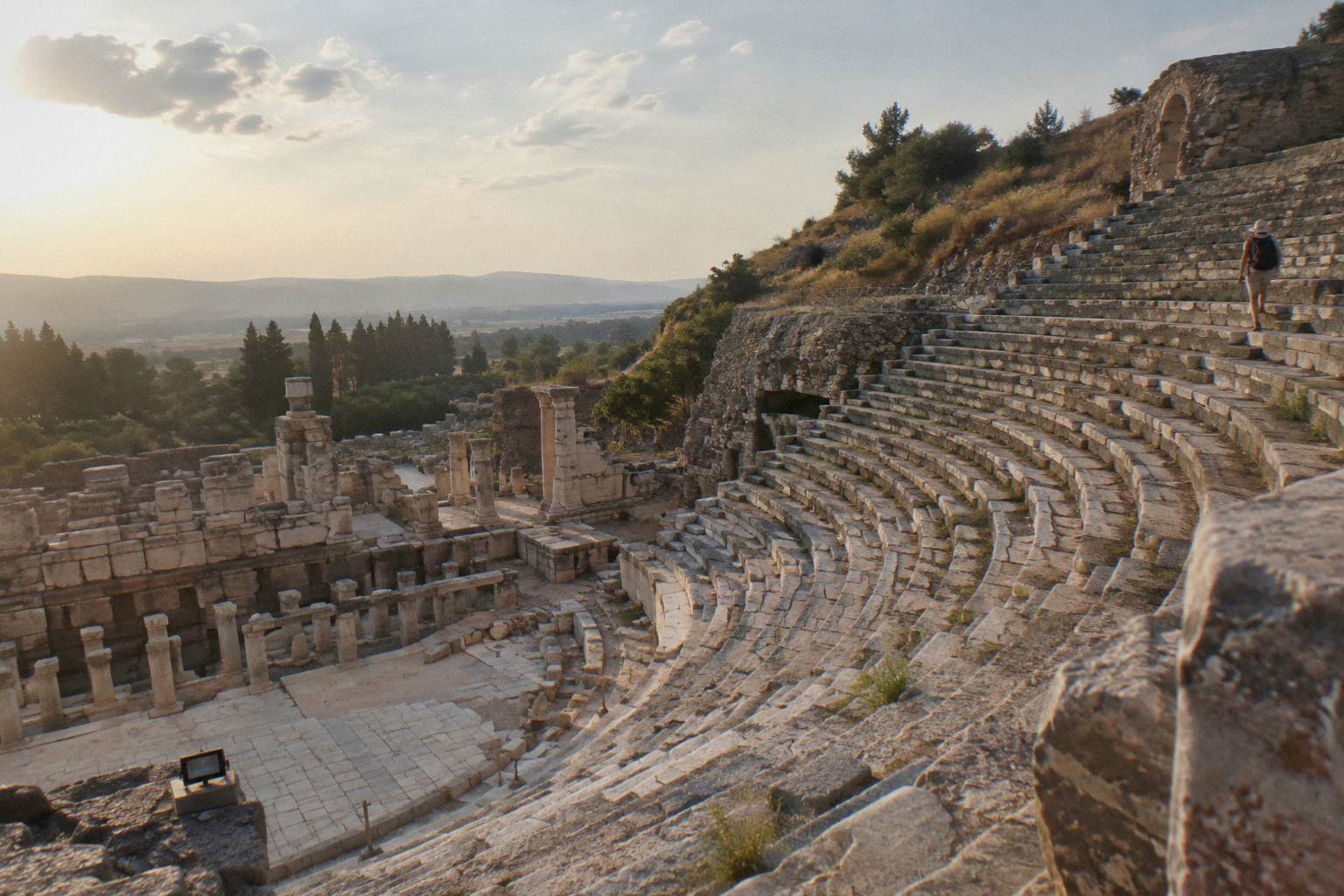
The Great Theatre, roughly 25,000 seats by the usual estimate, is the site of the Acts 19 riot. The Library of Celsus and Curetes Street sit on the downhill line between the upper and lower gates, about 1.5 km apart. A guided visit takes roughly 2 to 3 hours, and most tour lines name both the Theatre and the Library.
The Great Theatre at Ephesus holds roughly 25,000 seats by the usual estimate, and it is the one building in the ancient city where a specific New Testament event can be placed with confidence: the silversmiths' riot of Acts 19. The Library of Celsus anchors the other end of the visitor route. Curetes Street is the worn marble spine that joins them. Together these three monuments form the core of almost every guided walk through the site, and almost every tour line covered here names at least two of the three among its stops. Biblical Ephesus Tour covers how those tours differ; here the focus is on what the walk itself involves.
Where Does The Acts 19 Riot Fit In The Great Theatre?
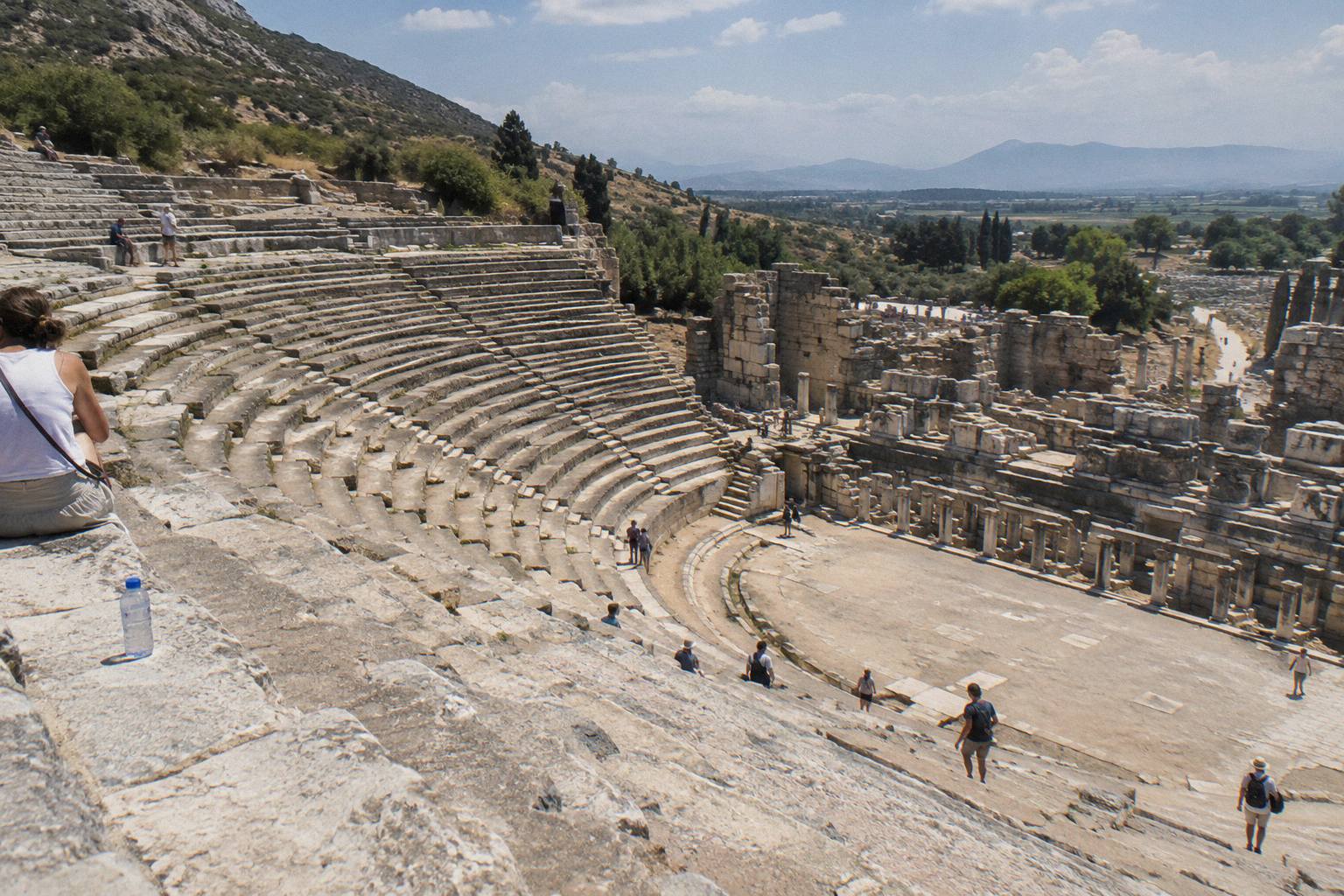
Acts 19:29 records that the crowd in Ephesus "rushed with one accord into the theatre" after seizing Gaius and Aristarchus, Paul's travelling companions. The Great Theatre is the building that crowd filled. It is also where the town clerk, in Acts 19:35, calmed the city by calling Ephesus "a worshipper of the great goddess Diana, and of the image which fell down from Jupiter".
The riot begins with Demetrius, a silversmith "which made silver shrines for Diana", who feared for his trade as Paul's teaching spread through the province of Asia. His speech turned the workshop into a mob, and the mob turned toward the theatre, the largest gathering place in the city. Acts 19:10 says Paul's teaching "continued by the space of two years; so that all they which dwelt in Asia heard the word of the Lord Jesus, both Jews and Greeks", which explains why the silversmiths felt the pressure. Paul's ministry length reads as two to three years when Acts 20:31 is set beside it, and the riot lands near the end of that stay.
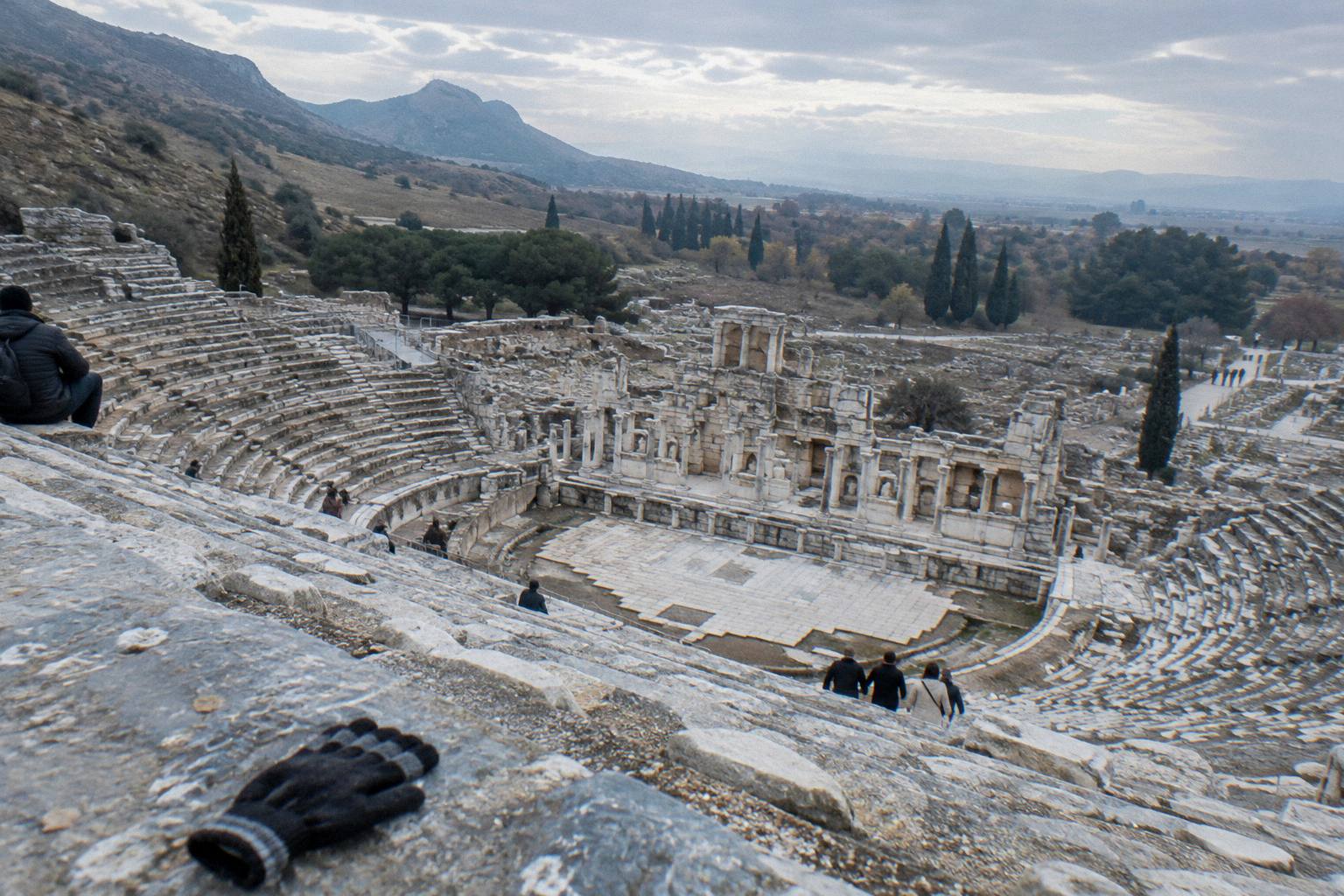
Standing in the Great Theatre, the scale of the event becomes concrete. A structure of roughly 25,000 seats, per the estimate given on the Ephesium overview of the ancient city, could hold a large share of the city's population; Acts 19:32 adds, in the surrounding narrative, that most of the crowd did not even know why they had gathered. A guide who knows the text can point from the cavea to the stage building and explain both the assembly and its dismissal.
The account also names the men caught up in it. Gaius and Aristarchus were Paul's travelling companions, seized and dragged into the theatre while Paul himself, according to the narrative, was restrained by disciples and even by provincial officials from going in. That detail matters on the ground: a guide can show how a crowd funnels into the cavea from the street side, and why entering the building mid-riot was dangerous enough for his friends to hold him back. The theatre at Ephesus is not a ruin to be admired from a distance; it is an event venue with the event written down.
The theatre is named on the Ministry of Culture and Tourism's page for the Ephesus Archaeological Site, alongside the Odeum, the Library of Celsus, bathhouses and the Agora. The same Ministry text describes Ephesus as "a key city in the expansion of Christianity, from which St Paul launched many of his missions". The site is open daily, with hours that shift by season; check the Ministry page on the day.
Which tours actually bring you here? The Great Theatre is a named stop on a clear group of the trips covered here:
| Tour | Duration | Rating | Great Theatre Named |
|---|---|---|---|
| Best-Seller Cruise Tour, Ticket Option | 4 hours to 6 hours | 4.9 from 1,190 reviews | Yes, a named stop |
| Travelshow Private, Lunch Included | 4 hours to 6 hours | 4.9 from 918 reviews | Yes, a named stop |
| Licensed Guide, Tickets Arranged | 4 hours to 6 hours | 4.8 from 84 reviews | Yes, a named stop |
| Skip-The-Line, Guaranteed Port Return | 4 hours to 6 hours | 4.8 from 29 reviews | Yes, a named stop |
| Turkey Tours, 6 To 8 Hours | 6 hours to 8 hours | Fewer than 20 reviews | Yes, a named stop |
| Guide Of Ephesus Private | 4 hours to 6 hours | 5.0 from 164 reviews | No; Library and Temple named instead |
Which Tours Name The Library Of Celsus?
The Library of Celsus is the most frequently named monument across the tours listed here, appearing on more tour lines than any other single stop after Ephesus itself. The Travelshow Private, Lunch Included tour, from $39.04 per person, names the Library, the Great Theatre, the Temple of Artemis, the House of the Virgin Mary and the Basilica of St John, with lunch and a guide with biblical expertise listed.
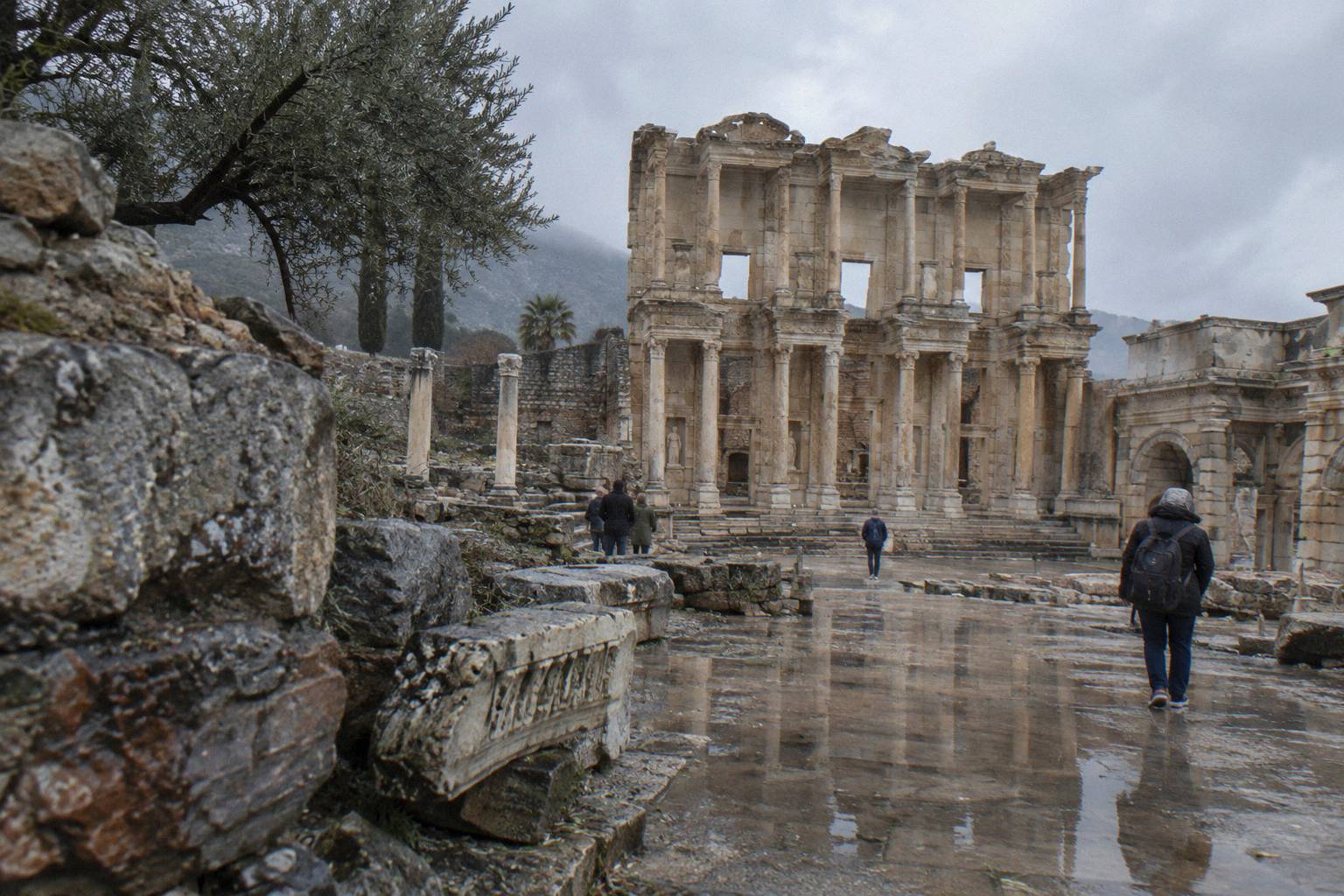
The Library is on the Ministry's own list of principal monuments at the site, and UNESCO included the ancient city on the World Heritage List in 2015 under criteria iii, iv and vi. Its reconstructed facade stands at the lower end of Curetes Street, and for most visitors it is the image they carried in their head before arriving. It is a Roman library, not a biblical site, but it sits directly on the route between the biblical landmarks, so no walk avoids it.
A reader who wants the Acts 19 theatre and the main street walked with a guide rather than alone has real choices among the trips covered here. The Travelshow private Bible tour from the port is the one that lists a guide with biblical expertise, and its price falls as the group grows, like every private trip here; the per-person figure from $39.04 is the starting point, never a group total. Check availability. Its exclusions name the Ephesus, House of Mary and Basilica of St John tickets, which are paid separately at the published Ministry fees (EUR, changes yearly, check before going).
The comparison below copies each tour's own stops, so the differences are visible at a glance. Note which lines name the Temple of Artemis alongside the Library and Theatre: that open, free site is the physical remainder of the goddess whose name the Acts 19 crowd shouted for two hours.
| Tour | Price | Duration | Library Of Celsus | Great Theatre | Curetes Street Named |
|---|---|---|---|---|---|
| Travelshow Private, Lunch Included | from $39.04 per person | 4 hours to 6 hours | Yes | Yes | Not mentioned |
| Private Skip-The-Line Access | from $49 per person | 4 hours to 6 hours | Not mentioned | Not mentioned | Not mentioned |
| Best-Seller Cruise Tour, Ticket Option | from $15 per person | 4 hours to 6 hours | Yes | Yes | Not mentioned |
| Guide Of Ephesus Private | from $22.73 per person | 4 hours to 6 hours | Yes | Not mentioned | Not mentioned |
| Licensed Guide, Tickets Arranged | from $39 per person | 4 hours to 6 hours | Yes | Yes | Not mentioned |
| On-Time Cruise Return, Private | from $39 per person | 5 hours to 7 hours | Yes | Yes | Not mentioned |
No tour line itemises Curetes Street as a stop. It is the street you walk between the named monuments, so it appears in the walking rather than in the itinerary wording. Any private tour's per-person price falls as the group grows; the figures above are starting points.
Read the table with one caveat in mind. A dash in the Great Theatre column does not mean the tour skips the building; several lines name a short list of stops while walking the same standard route. What the column shows is what the operator promises in writing, and a stop that is promised is a stop a guide is accountable for. For a reader whose priority is the Acts 19 location, choosing a line that names the Theatre removes the guesswork entirely.
How Long Does Curetes Street Take To Walk?
Curetes Street runs downhill through the ancient city on worn, uneven marble, and the full route from the upper Magnesian gate to the lower Harbour gate is about 1.5 km one way. A visit to the site takes roughly 2 to 3 hours, and most of that time is spent on or beside this street, which is why footwear matters more than distance here.
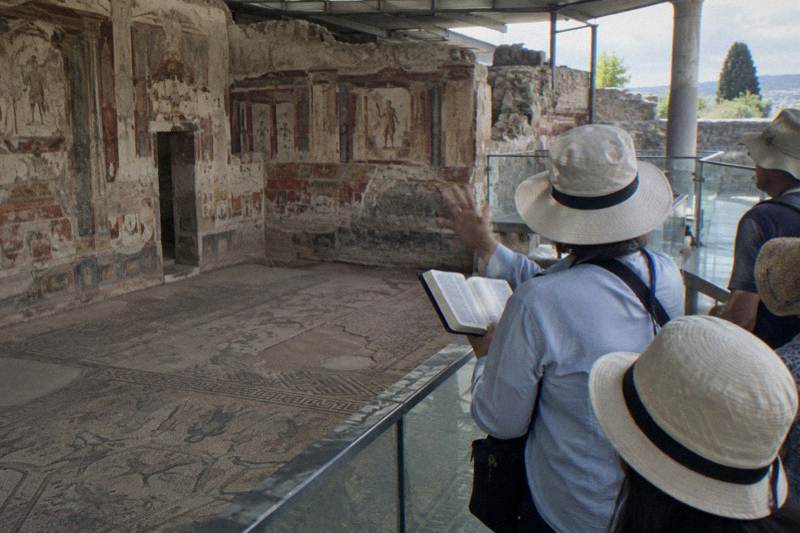
Curetes Street was one of the main arteries of Roman Ephesus, lined with monuments, shops and baths, sloping from the upper city toward the Library end. The Marble Road and Curetes Street are both worn, uneven marble underfoot: polished ridges, broken slabs and steps. Visitor guides report that the walk downhill from the upper gate is the natural direction, and that the lower gate gives the flatter route to the Library and the Theatre. Anyone with mobility concerns should weigh that the second Ministry page also confirms: the Terrace Houses, which open off Curetes Street mid-route, involve stairs and walkways and are not wheelchair accessible.
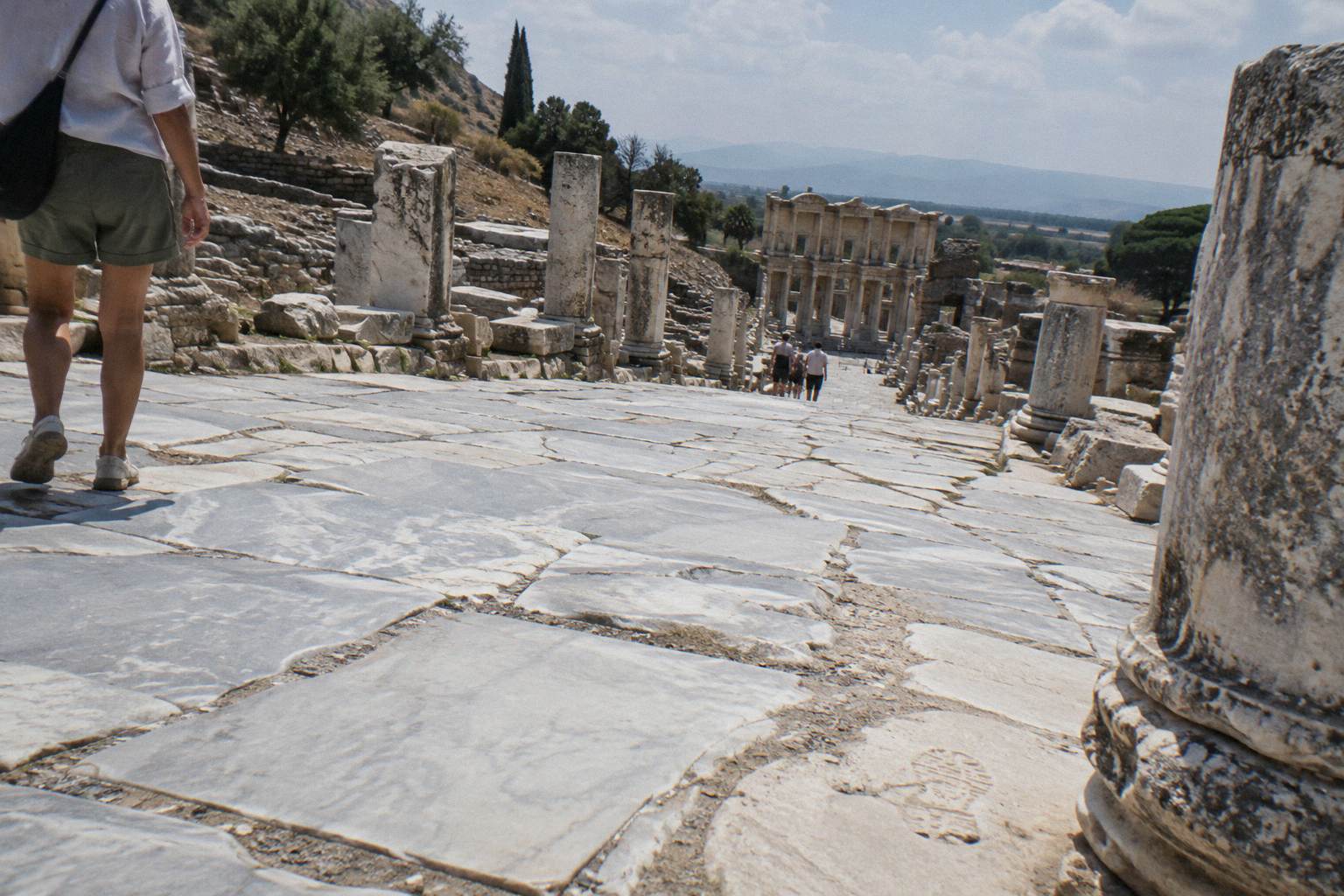
For the biblical reading, the street is where ordinary Ephesian life happened during Paul's two to three years in the city. Acts 19:8 says "And he went into the synagogue, and spake boldly for the space of three months...", and the agora and the streets around it were the commercial world Demetrius spoke for when he warned that "the temple of the great goddess Diana" was being despised. Walking the street with a guide connects the text to the pavement; walking it alone, it is a handsome ruin.
The commercial layer deserves a moment of its own. The silver shrines of Acts 19 were devotional souvenirs, and Curetes Street and the roads off it were where pilgrims, traders and craftsmen mixed. A guide who explains that economy before the Theatre stop makes the riot read as a labour dispute with a religious edge rather than a sudden inexplicable frenzy. That framing is the whole argument for a guided walk over a solo one on this particular street.
The timing question is usually a port question. Kuşadası, the Ege cruise port, is roughly 20 to 35 minutes from the ruins by road, and cruise calls there typically run 8 to 11 hours, with the ship's own all-aboard time governing. The shore excursion timing and back-to-ship guide covers the arithmetic in full; here it is enough to say that a 4 to 6 hour tour comfortably holds the 2 to 3 hour walk plus transfers.
A practical note on what the street does to feet: closed shoes with grip beat sandals on the polished marble, and the surface is uneven enough that a guide's pacing matters for anyone unsteady. The what to wear on a Bible tour post treats clothing and footwear in detail.
Is The Lower Gate The Easier Way To Reach The Library And Theatre?
Yes, by the reported layout of the site. Visitor guides describe the lower Harbour gate as the flatter approach to the Library of Celsus and the Great Theatre, with the steeper, stepped terrain concentrated uphill around the Terrace Houses and the upper gate. A visitor who enters low can see the two headline monuments with far less climbing.
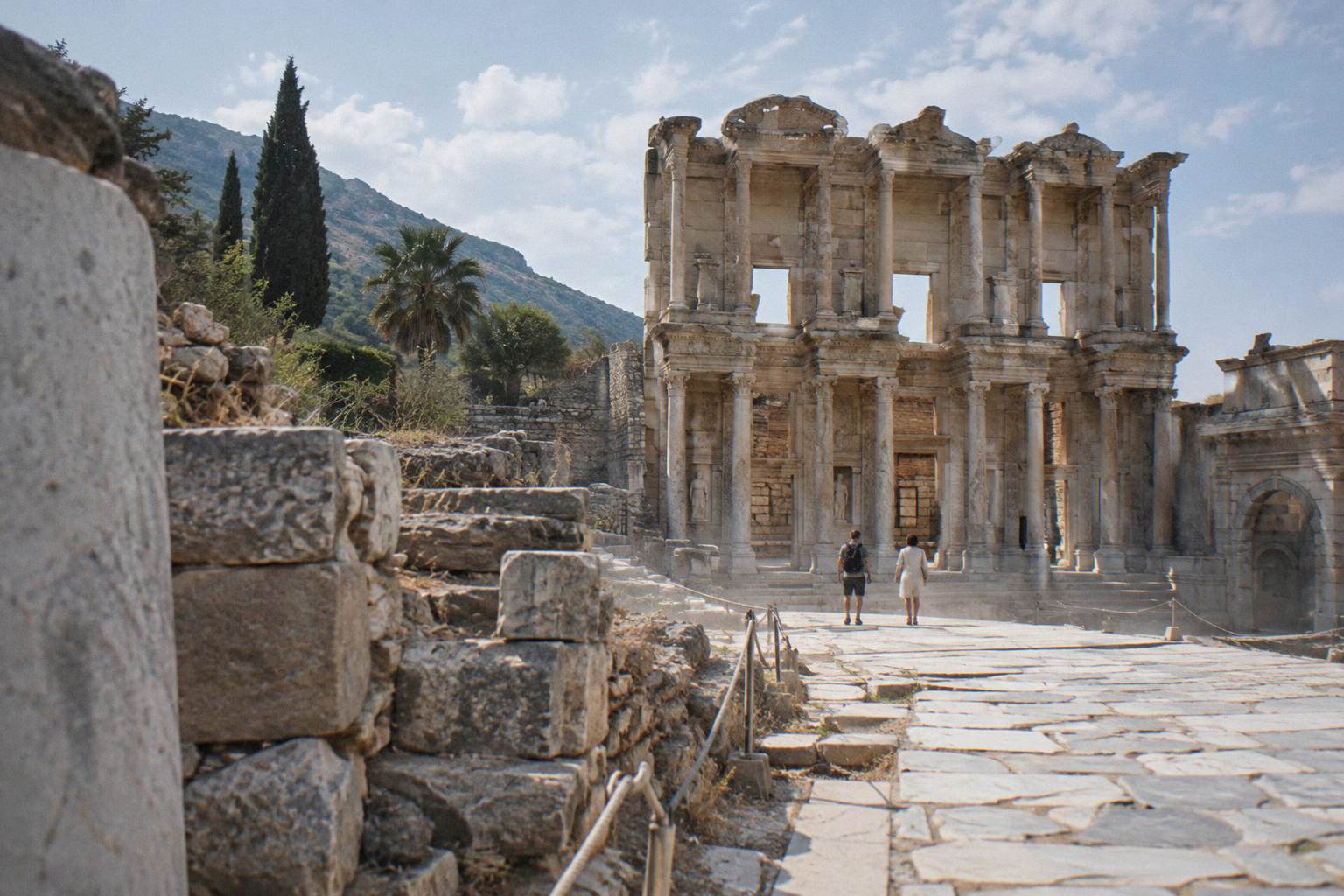
The two monuments sit close to the lower end. The Library facade faces onto the street near the lower gate, and the Great Theatre is a short way beyond it toward the Harbour direction, with the Odeum and the bathhouses between them on the Ministry's monument list. Entering from the top gives the classic downhill panorama of Curetes Street, but it spends the walking budget early on uneven marble.
| Route | Terrain As Reported | What You Pass | Best Suited To |
|---|---|---|---|
| Upper (Magnesian) gate, downhill | Worn uneven marble, downhill, steps near the Terrace Houses | Curetes Street end to end, Terrace Houses entrance, then the Library and Theatre | Full 2 to 3 hour visits, steady feet |
| Lower (Harbour) gate, inward | Flatter route to the Library and Theatre | Library facade and Great Theatre first, street climbed partway | Shorter calls, mobility caution |
| Either gate with a licensed guide where a tour line lists one | Guide sets the pacing | Same monuments, ordered to the text | Readers who want Acts 19 placed on the ground |
Guides who list their own licensed credentials include the Guide Of Ephesus Private tour (5.0 from 164 reviews, from $22.73 per person), whose line lists "a professional, licensed local tour guide authorized by the Ministry of Tourism and Culture", a lunch in the countryside, and stated on-time return for cruise passengers, with the ship's all-aboard time still governing. Its stops name the Library of Celsus, the Temple of Artemis and the House of the Virgin Mary rather than the Theatre; tickets are paid separately, arranged by the guide in cash.
The licensed guide and tickets arranged tour is the other side of the same coin: its line lists a licensed local guide for the whole day, port or hotel pickup and drop-off, and both the Library and the Great Theatre among its stops, from $39 per person (4.8 from 84 reviews). Entrance fees are excluded; the operator arranges the tickets in advance so guests skip long ticket lines.
What Should You Read Before Standing In The Theatre?
Read Acts 19:24 to 19:35 before the visit, and it transforms the largest building at Ephesus from a photo stop into the setting of a documented assembly. The passage names the theatre, the silversmiths, the goddess and the town clerk, and every one of those has a physical counterpart on or beside the route you walk.
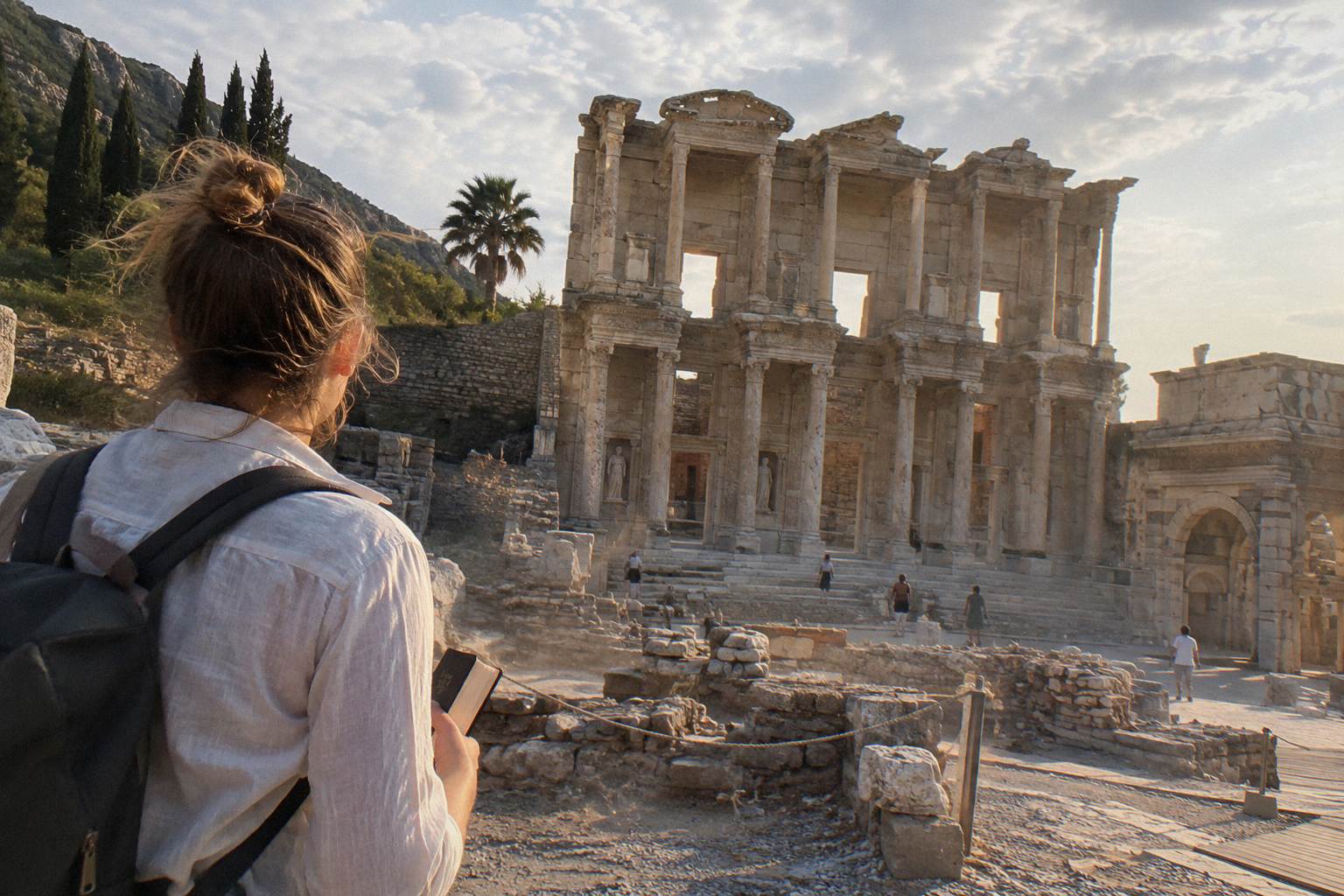
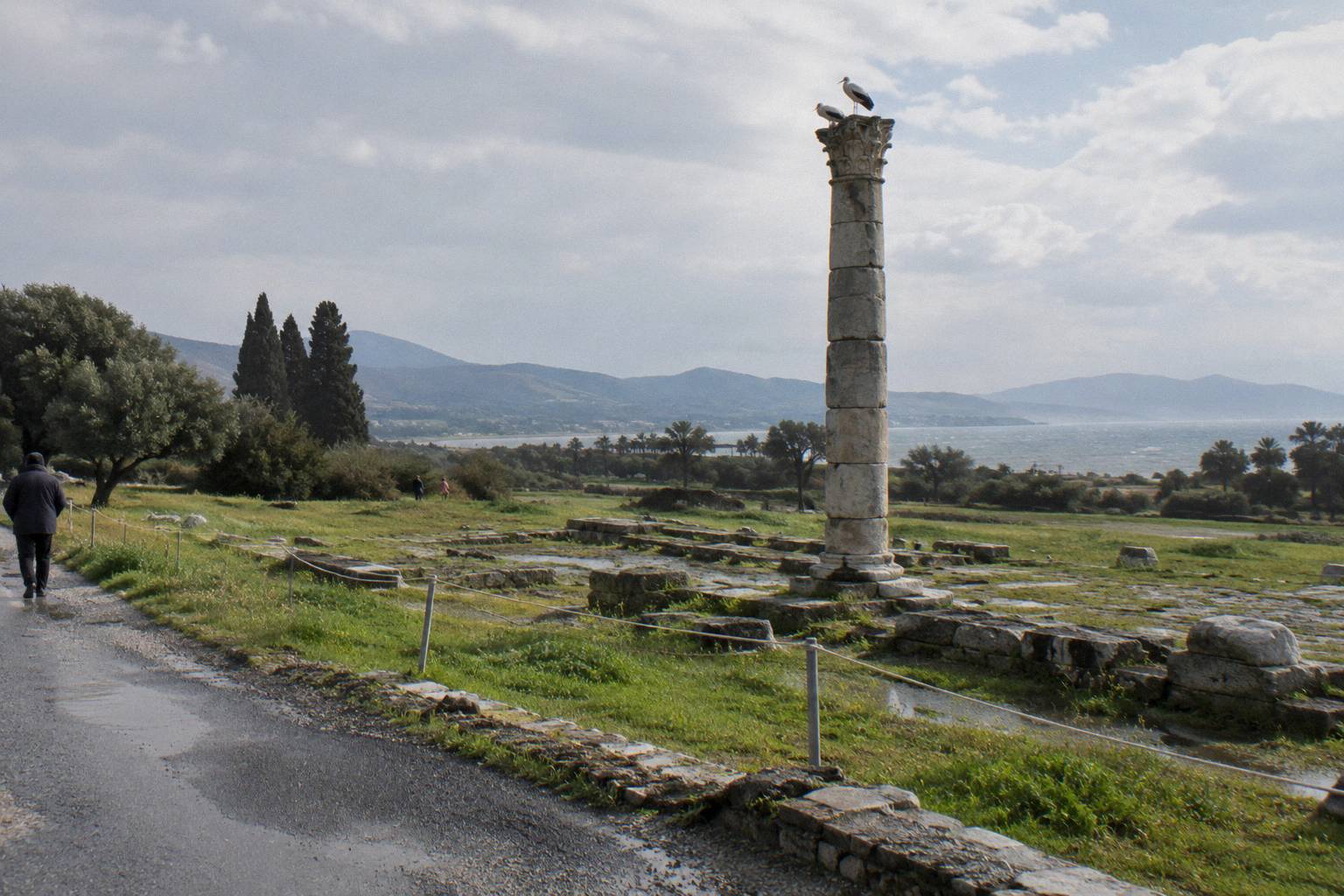
The sequence is compact. Demetrius, who "made silver shrines for Diana", addresses the craftsmen. The crowd cries "Great is Diana of the Ephesians" (Acts 19:28). Acts 19:29 places them in the theatre with Gaius and Aristarchus. Acts 19:35 gives the clerk's dismissal, calling the city "a worshipper of the great goddess Diana, and of the image which fell down from Jupiter". The Temple of Artemis, today one re-erected column among foundations on an open, free site on the Selçuk side road, is the shrine all of this revolved around; the Temple of Artemis on a biblical tour guide covers that site separately.
Two further texts deepen the walk. 1 Corinthians 16:8-9, written from Ephesus, says "But I will tarry at Ephesus until Pentecost. For a great door and effectual is opened unto me, and there are many adversaries"; the adversaries are usually read to include the scene in the theatre. And 1 Corinthians 15:32 adds "If after the manner of men I have fought with beasts at Ephesus, what advantageth it me, if the dead rise not?", a verse linked by tradition to this arena. Ephesians 1:1 addresses "the saints which are at Ephesus", though where and by whom that letter was written is debated, so never tie its composition to the city. The reading the letter to the Ephesians guide treats that question in full.
Revelation adds a fourth layer. The letter to the church in this city opens "Unto the angel of the church of Ephesus write..." and closes with "To him that overcometh will I give to eat of the tree of life, which is in the midst of the paradise of God" (Revelation 2:1, 2:7). The standing at the site of the Revelation letter guide follows that text through the ruins; on the Theatre-and-Street walk it is enough to know that the same city received both the riot of Acts 19 and the rebuke of Revelation 2:4.
Tours that build the visit around scripture rather than around ruins are a specific subset here. The All Inclusive Private, Lunch tour (5.0 from 1,137 reviews, from $151.20 per person, 5 hours to 7 hours) lists entrance fees as included, a private licensed guide, lunch, and an on-time return for cruise guests, though its line names only Ephesus and the House of the Virgin Mary as stops. For the Theatre-and-Library walk specifically, the Travelshow line is the one that names both and lists the Bible-oriented guide.
Reading list, kept to the strings above so nothing is paraphrased into error:
- Acts 19:24-28 for the riot's cause and the crowd's cry.
- Acts 19:29 for the theatre itself.
- Acts 19:35 for the clerk's words naming the goddess and her image.
- Acts 19:10 with Acts 20:31 for the two to three years of Paul's stay.
- Revelation 2:1-7 for the letter to the church in this city.
Common Questions About The Great Theatre And Library Of Celsus
Is The Great Theatre The One From Acts 19?
Yes. Acts 19:29 records the crowd rushing into the theatre, and the Great Theatre is the large assembly building the Ministry names at the site, roughly 25,000 seats by the usual estimate. The smaller Odeum also stands at Ephesus, but the riot account points to the city's principal theatre.
Is The Library Of Celsus In The Bible?
No. The Library is a Roman monument built after the New Testament period, named on the Ministry page and on many tour lines. Its value on a biblical walk is positional: it anchors the lower end of Curetes Street beside the route to the Theatre.
How Far Is The Walk From Gate To Gate?
About 1.5 km one way from the upper Magnesian gate to the lower Harbour gate, downhill from the upper gate, on worn and uneven marble. A full visit takes roughly 2 to 3 hours, and the lower gate gives the flatter approach to the Library and Theatre.
Which Tours Name Both The Theatre And The Library?
Several lines name both, including Travelshow Private, Lunch Included (4.9 from 918 reviews, from $39.04 per person, guide with biblical expertise listed), Best-Seller Cruise Tour, Ticket Option (4.9 from 1,190 reviews, from $15 per person), and Licensed Guide, Tickets Arranged (4.8 from 84 reviews, from $39 per person).
Are The Theatre And The Library Inside The Ephesus Ticket?
The main site's published Ministry fee is EUR 40 for non-Turkish adults (published fee, changes yearly, check before going), and the Theatre, Library and Curetes Street are all within the main site. Only the Terrace Houses, EUR 15, are a separate ticket. Where a tour lists entrance fees as excluded, the ticket is paid separately.
Is The Walk To The Theatre Difficult?
Curetes Street and the Marble Road are worn, uneven marble, and the Terrace Houses along the route involve stairs and are not wheelchair accessible. Entering from the lower gate reaches the Library and Theatre on the flatter reported route. The wheelchair accessibility on a tour post treats this question in full.
One closing pointer for choosing between them: the Turkey Tours, 6 To 8 Hours trip (from $25.62 per person, lunch and a licensed guide listed, fewer than 20 reviews so far) is the longest-day option of the three above and also names both the Great Theatre and the Library of Celsus. Its line runs 6 to 8 hours from Kuşadası port with a deluxe lunch, a bottle of water, insurance and a licensed guide included, and entrance fees paid separately. For a fuller comparison of the group and private formats, the private Bible tour what you pay for guide breaks down where the money goes.